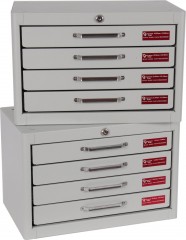
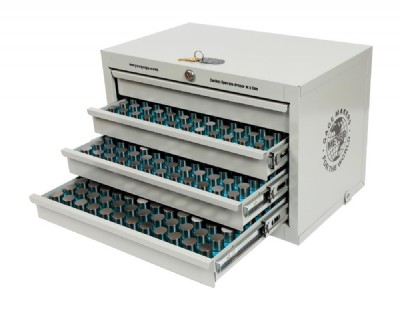
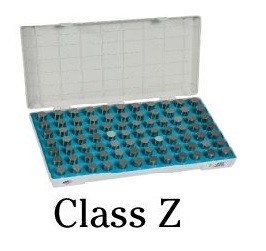
- Each set contains 25 pieces of Class X tolerance (.00004”) gage pins.
- Traceable to NIST
- Choice of two tolerances: Plus (+.00004”) or Minus (-.00004”)
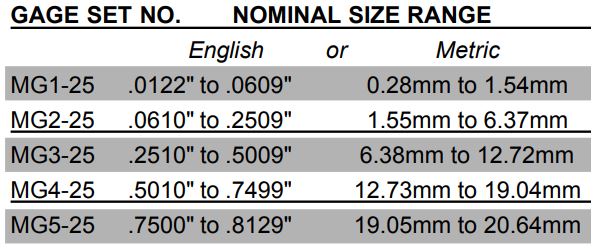
- Sets consist of a center nominal size, and 12 gages larger in .0001” steps and 12 gages smaller in .0001” steps. Metric sets available in 0.01mm increments.
- Each gage is inspected and has a 2 microfinish or better.
- Heat treated and through hardened to 60-62 Rockwell C
- All pin gages over .060” or 1.51 mm are laser marked with size direction of tolerance and serial number for traceability.
- Delivery is estimated at 20 weeks from the MFG.

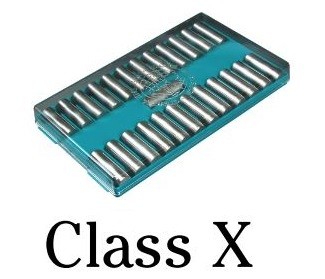
Meyer - MG-25 Plug Gage Sets - Class "X" - 25 Piece - .01mm Increments - (Metric)
Click here for INCH sizes
Filter Products:
Enter NOMINAL (center) Pin Size (4 digit number with decimal):
Tolerance Direction :
| Item No. | Size Range | Tolerance Direction | Our Price | QTY |
|---|---|---|---|---|
| MG1-25PMETRIC | 0.40mm - 3.18mm | Plus | $500.00 | |
| MG1-25MMETRIC | 0.40mm - 3.18mm | Minus | $500.00 | |
| MG2-25PMETRIC | 3.19mm - 6.35mm | Plus | $400.00 | |
| MG2-25MMETRIC | 3.19mm - 6.35mm | Minus | $400.00 | |
| MG3-25PMETRIC | 6.36mm - 9.53mm | Plus | $320.00 | |
| MG3-25MMETRIC | 6.36mm - 9.53mm | Minus | $320.00 | |
| MG4-25PMETRIC | 9.54mm - 12.70mm | Plus | $380.00 | |
| MG4-25MMETRIC | 9.54mm - 12.70mm | Minus | $380.00 | |
| MG5-25PMETRIC | 12.71mm - 15.88mm | Plus | $460.00 | |
| MG5-25MMETRIC | 12.71mm - 15.88mm | Minus | $460.00 | |
| MG6-25PMETRIC | 15.89mm - 22.23mm | Plus | $520.00 | |
| MG6-25MMETRIC | 15.89mm - 22.23mm | Minus | $520.00 |
Features:
- Used as masters to calibrate measuring equipment and check linearity of comparators, micrometers, and calipers.
- These ‘Tenth Step” gage sets have unlimited applications, such as quality control inspection, prototype work and production layout.
- Inspectors select from the range of pins to find the size of a hole or slot.
- These round masters simulate a cylindrical part which, unlike flat blocks, can detect uneven wear on the tips of micrometers and calipers.
- The thin “line” of contact detects uneven face wear better than flat gage blocks with large contact area.